YMCA East Surrey
Banner Image

Evidenced-based Therapies

YMCA East Surrey’s Emotional Wellbeing and Mental Health team offers three specialist evidence-based therapies for adolescents.

Children’s Wellbeing Practitioners

YMCA East Surrey’s Children’s Wellbeing Practitioner (CWP) team provides guided self-help for children and young people experiencing:

  • Mild to moderate anxiety
  • Low mood
  • Common behavioural challenges

Our CWPs are part of YMCA East Surrey’s Emotional Wellbeing and Mental Health service, working across the local community, GP practices, and schools.

Who We Support

We offer support to children and young people aged 4 to 18, using either:

  • Parent-led interventions (typically for younger children)
  • Child/young person-led interventions (for older children and teens)

Our Approach

CWPs use Cognitive Behavioural Therapy (CBT) principles to help normalise emotions and build healthier patterns of thinking, feeling, and behaviour through structured self-help strategies.

Referrals & Contact

CWPs accept referrals from:

  • Professionals
  • Parents and carers
  • Young people aged 16+

Before making a referral, we ask that you first speak with a member of our team. Please email us at: childrenswellbeingpractice@ymcaeastsurrey.org.uk

Scan the QR code below to access our CWP referral form.

Can refer:

  • Low mood / Depression / Low self-esteem (mild to moderate)
  • Young person already engaged in a different intervention
  • Anxiety including social anxiety and separation anxiety (mild to moderate)
  • Excessive worry
  • Stress
  • Fears / Phobias
  • Panic symptoms (not panic disorder)
  • School avoidance
  • Sleep difficulties
  • Poor diet / eating patterns that may be causing or affecting mood
  • Healthy / Active lifestyle
  • Young carers
  • Peer difficulties

Exclusions (cannot refer):

  • Young person already engaged in a different intervention
  • Formal diagnosis of Autism Spectrum Disorder or severe learning disabilities
  • High-risk self-harm
  • Concerns that are more than mild to moderate
  • Eating disorders
  • OCD
  • PTSD
  • Panic disorder

Cost

Our service is free for all clients.

Confidentiality

We understand how important trust is. Everything shared with us remains confidential and will not be passed on outside YMCA East Surrey or our NHS partners without your consent, unless we believe you or someone else is at risk. In such cases, we will always try to discuss it with you first.
Cognitive Behavioural Therapy (CBT)

What is CBT?
CBT is a type of talking treatment that focuses on how your thoughts, beliefs and attitudes affect your feelings and behaviours. It teaches you coping skills to deal with different problems. CBT combines cognitive therapy (examining the things you think) with behaviour therapy (examining the things you do). It is a here and now therapy, so you will look at what is currently keeping your difficulties going. You might also explore the past to understand the impact it has had.

How does CBT work?
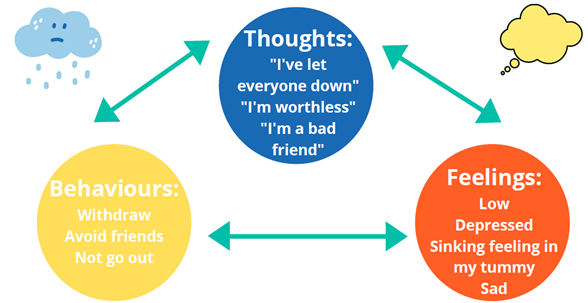
CBT is based on the idea that the way you think about situations can affect the way you feel and behave. For example, if you interpret a situation negatively, you might experience negative emotions as a result. These bad feelings might then lead you to behave in a certain way. This can then become a vicious cycle that is difficult to break. We can look at it like this:

What will happen in my CBT session?
Meetings with your therapist will be private and usually last for 50 minutes. You will be offered a safe and non-judgemental space to explore what is going on for you in the here and now.

At the start of treatment, you will ‘map’ out your difficulties and create specific goals to work towards throughout therapy. At the start of each session, you and your therapist will put together an agenda for the session. Depending on your focus, together you will work through different worksheets, questionnaires and tasks which will help you learn different coping strategies. For these strategies to work, it is important you engage in ‘in-between session tasks’ which your therapist will set you, to strengthen your learning. To get the best possible outcome, you must be willing and able to engage in your sessions and work collaboratively with your therapist.

Most young people are offered the opportunity to come for around 8 weekly sessions with one of our CBT therapists.

What kinds of problems can CBT help with?

  • Anxiety: Confronting fears in a gradual and manageable way. Exploring coping strategies.
  • Low mood/depression: Recording thoughts. Incorporating valued activities into your week.
  • Sleep: Challenging difficult thoughts.
  • Phobias: Gradual exposure to feared situations.
  • Problems relating to others: Checking assumptions about other people’s motivation for doing things.

Interpersonal Psychotherapy for Adolescents (IPT-A)

What is IPT-A?
IPT-A is an evidence-based treatment specially developed for dealing with Depression in Children and Young People.

IPT-A focuses on the relationship difficulties that are often very important to young people and that are frequently identified as key features of their depression stories.

The focus of this type of therapy will be on current conflicts, role changes, losses and difficulties in establishing and maintaining independent and satisfying relationships that so often trigger and maintain episodes of depression. IPT-A aims to reduce depressive symptoms and improve relationships through a collaborative process of psychoeducation, understanding depression in the context of relationships with other people, developing skills in identifying and expressing feelings and moods and communicating more effectively.

IPT-A is mainly an individual therapy but relationships can be more fully explored through additional sessions with parents/carers.

What will happen in my IPT-A session?
With your therapist, you will talk about your symptoms; how you feel and what is happening in your relationships week-by-week. Your therapist will support you to make positive changes. You will be helped to get back into routines that might have felt more difficult since your depressive symptoms started.